Making development of autonomous red-teaming systems visual and understandable
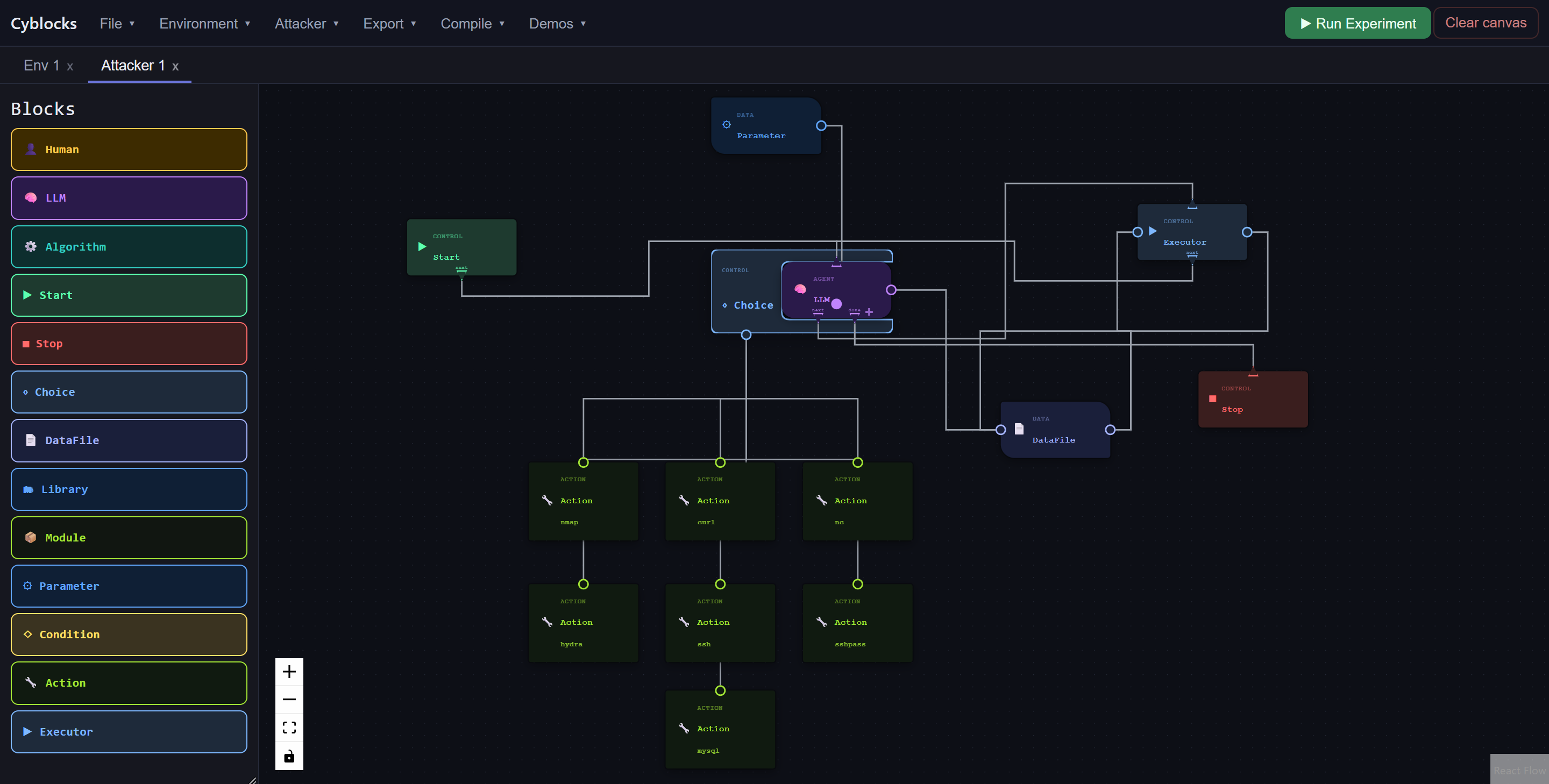
- Existing agentic multi-host red-teaming (AMR) systems are complicated and difficult to develop.
- To solve this issue, we created CyBlocks: a visual coding tool for developing AMR systems quickly and legibly.
- The first version of CyBlocks can be found here.
Current state
Agentic multi-host red-teaming (AMR) systems are becoming more powerful and popular. Popular examples include ARTEMIS, Incalmo, CAI, and PentestGPT. However, such systems usually consist of massive codebases. For example, PentestGPT’s codebase consists of around 23k lines of code, and Incalmo’s codebase reaches 38k lines of code.
Problem
Currently, the complexity and size of AMR systems introduces a multitude of usability problems:
- Difficult to develop. Creating AMR systems requires a high level of domain expertise in both security and software development. Maintaining such a system also requires deep knowledge of how it was built in the first place.
- Difficult to use. Security professionals, non-security professionals such as policy analysts, executives and students may be unable to use an AMR system correctly or effectively without clearly legible internals.
- Difficult to understand. Scientists, developers, and students have little clarity into why one system might work better than another due to the complexity of the codebase.
Programmers, pentesters, scientists, and non-domain experts all experience these same kinds of problems, which creates a high barrier for entry to autonomous cybersecurity experimentation.
Approach & Challenges
In other domains, visual coding is a popular solution for lowering the barrier of entry to software development. Currently, many visual programming platforms exist that serve different domains, such as Scratch lowering the barrier of entry for programming education, and Google Visual Blocks for quickly building ML pipelines. There are also visual development platforms for agentic workflows such as n8n, LangGraph, and Agent Bricks, which help developers compose models, tools, and control logic through abstractions.
However, the unique characteristics of AMR systems make them incompatible with existing visual coding solutions.
- Environmental challenges. In contrast with more typical programming settings, AMR systems operate in uncertain, external environments. A visual coding solution must handle unpredictable status and a dynamic environment.
- Diverse toolkits. The tools available to an attacker range vastly in functionality, with new tools being introduced to the broader cybersecurity community every day. A visual coding system must be expressive and flexible enough to integrate new functionality with ease.
- Control/data flow. AMR systems are heavily interconnected and work with live and external services. Therefore, representing their control and data flow visually is difficult without creating a clutter that reduces readability.
To this end, our objective is to create a visual coding IDE that can make the development of autonomous red-teaming systems easier and more understandable.
Solution
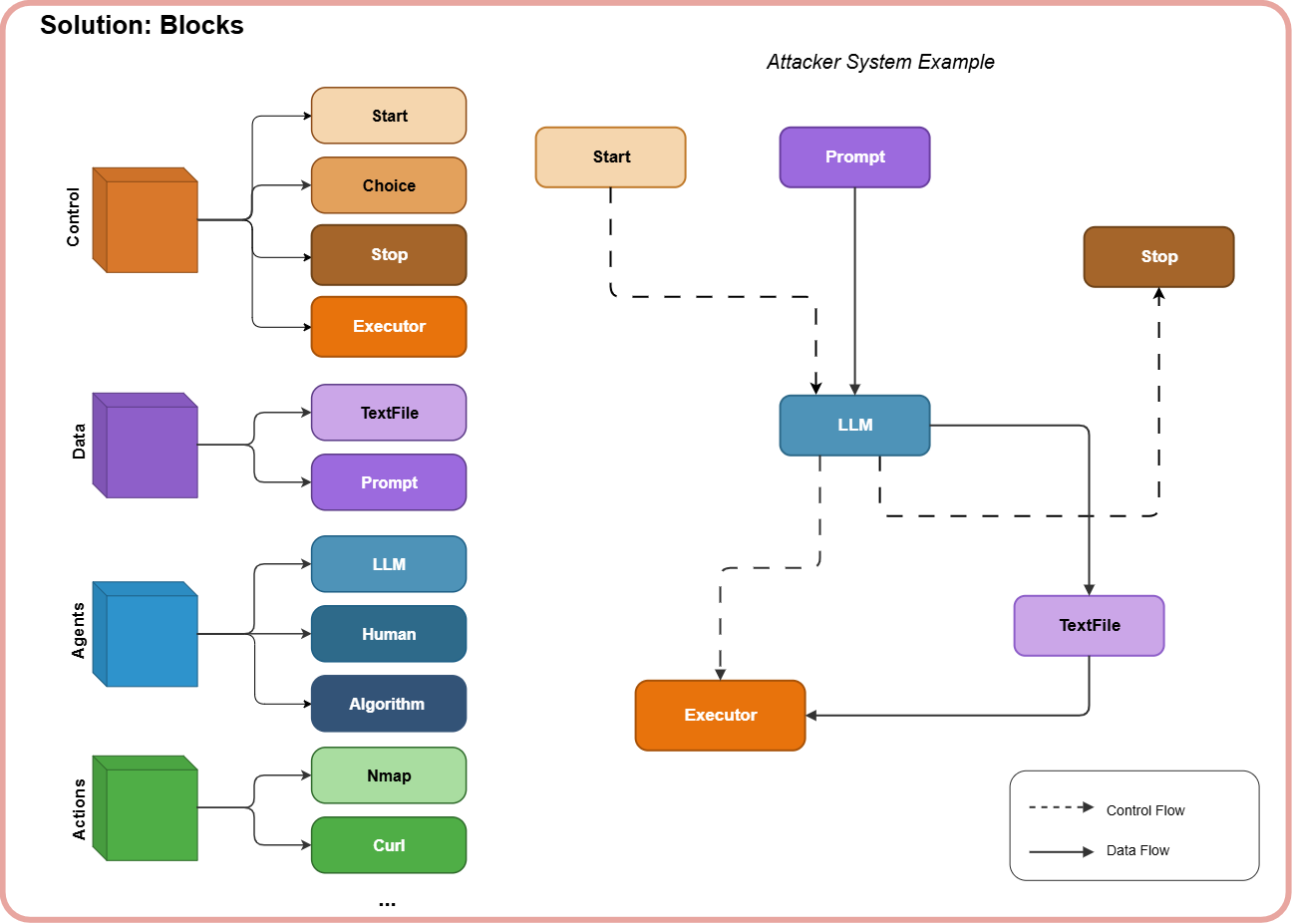
To accomplish this, our plan consisted of two phases. First, we created a more general abstraction of the building blocks used to compose AMR systems, along with the families that the blocks belong to. Second, we did an initial implementation of the block set, validating it by replicating functionality from actual AMR systems.
To derive the abstractions, we conducted a literature review of existing AMR systems (Incalmo, PentestGPT, CAI). Across different architectures, the same block-level abstraction kept recurring, along with a consistent pattern of control and data flow around the system. This allowed us to construct the initial block set abstraction derived from the diagrams and assigned them to different families of blocks (Agents, Control, Data, Actions) based on their functionality throughout the attack. Each block represents a code module that can be used as a step in the attack flow.
As proof of concept that our IDE and abstracted blocks are capable of building offensive cybersecurity systems, we replicated PentestGPT and a simplified version of Incalmo.
In addition to the attacker functionality, we also implemented an environment creation toolkit that deploys local Docker containers - no testbed needed to get testing!
Project Status and Future Vision
Our ultimate goal is to lower the barrier to entry for the Cyber autonomy experimentation by expanding CyBlocks to support entire system handling from environments to offensive and defensive operations and analysis.
Currently, CyBlocks V0.0.1 is released.
- Set up CyBlocks on your local machine by following the instructions in our README.md.
- Follow the instructions on our Github to construct your own attack systems or try the existing demo attacks.
- If you have any ideas or suggestions on how to improve CyBlocks, please reach out.